Chapter 3 - Section 2
Controlled Airspace
28 min read
Source: https://www.faa.gov/air_traffic/publications/atpubs/aim_html/chap3_section_2.html
**General
{ #3-2-1}
**
- Controlled Airspace. A generic term that covers the different classification of airspace (Class A, Class B, Class C, Class D, and Class E airspace) and defined dimensions within which air traffic control service is provided to IFR flights and to VFR flights in accordance with the airspace classification. (See FIG 3-2-1.)
- IFR Requirements. IFR operations in any class of controlled airspace requires that a pilot must file an IFR flight plan and receive an appropriate ATC clearance.
- IFR Separation. Standard IFR separation is provided to all aircraft operating under IFR in controlled airspace.
- VFR Requirements. It is the responsibility of the pilot to ensure that ATC clearance or radio communication requirements are met prior to entry into Class B, Class C, or Class D airspace. The pilot retains this responsibility when receiving ATC radar advisories. (See 14 CFR Part 91.)
- Traffic Advisories. Traffic advisories will be provided to all aircraft as the controller's work situation permits.
- Safety Alerts. Safety Alerts are mandatory services and are provided to ALL aircraft. There are two types of Safety Alerts:
-
Terrain/Obstruction Alert. A Terrain/Obstruction Alert is issued when, in the controller's judgment, an aircraft's altitude places it in unsafe proximity to terrain and/or obstructions; and
-
Aircraft Conflict/Mode C Intruder Alert. An Aircraft Conflict/Mode C Intruder Alert is issued if the controller observes another aircraft which places it in an unsafe proximity. When feasible, the controller will offer the pilot an alternative course of action.
FIG 3-2-1 **
Airspace Classes**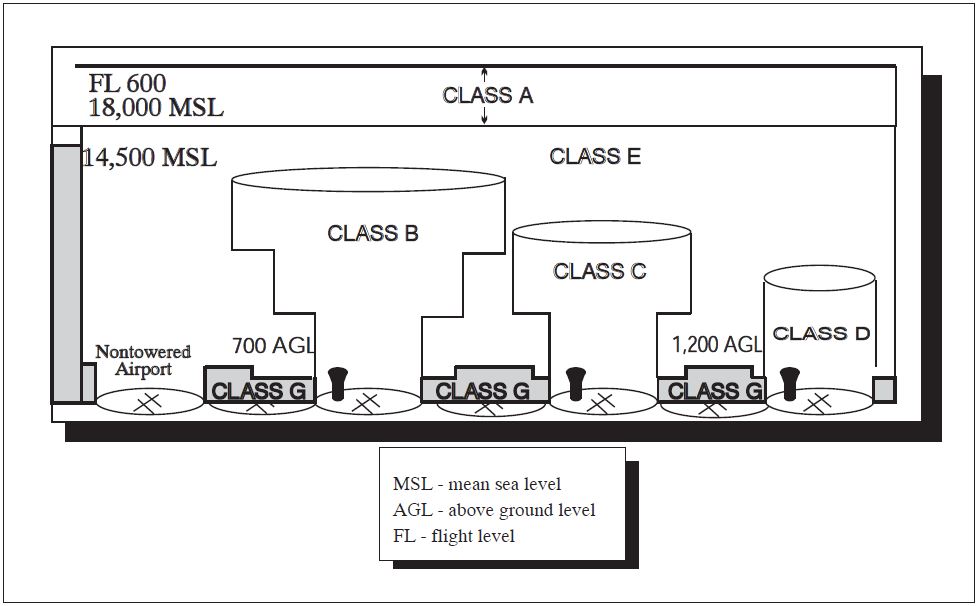
-
- Ultralight Vehicles. No person may operate an ultralight vehicle within Class A, Class B, Class C, or Class D airspace or within the lateral boundaries of the surface area of Class E airspace designated for an airport unless that person has prior authorization from the ATC facility having jurisdiction over that airspace. (See 14 CFR Part 103.)
- Unmanned Free Balloons. Unless otherwise authorized by ATC, no person may operate an unmanned free balloon below 2,000 feet above the surface within the lateral boundaries of Class B, Class C, Class D, or Class E airspace designated for an airport. (See 14 CFR Part 101.)
- Parachute Jumps. No person may make a parachute jump, and no pilot-in-command may allow a parachute jump to be made from that aircraft, in or into Class A, Class B, Class C, or Class D airspace without, or in violation of, the terms of an ATC authorization issued by the ATC facility having jurisdiction over the airspace. (See 14 CFR Part 105.)
**Class A Airspace
{ #3-2-2}
**
- Definition. Generally, that airspace from 18,000 feet MSL up to and including FL 600, including the airspace overlying the waters within 12 nautical miles off the coast of the 48 contiguous States and Alaska; and designated international airspace beyond 12 nautical miles off the coast of the 48 contiguous States and Alaska within areas of domestic radio navigational signal or ATC radar coverage, and within which domestic procedures are applied.
- Operating Rules and Pilot/Equipment Requirements. Unless otherwise authorized, all persons must operate their aircraft under IFR. (See 14 CFR Section 71.33, Sections 91.167 through 91.193, Sections 91.215 through 91.217, and Sections 91.225 through 91.227.)
- Charts. Class A airspace is not specifically charted.
**Class B Airspace
{ #3-2-3}
**
-
Definition. Generally, that airspace from the surface to 10,000 feet MSL surrounding the nation's busiest airports in terms of IFR operations or passenger enplanements. The configuration of each Class B airspace area is individually tailored and consists of a surface area and two or more layers (some Class B airspace areas resemble upside‐down wedding cakes), and is designed to contain all published instrument procedures once an aircraft enters the airspace. An ATC clearance is required for all aircraft to operate in the area, and all aircraft that are so cleared receive separation services within the airspace. The cloud clearance requirement for VFR operations is “clear of clouds.”
-
Operating Rules and Pilot/Equipment Requirements. Regardless of weather conditions, an ATC clearance is required prior to operating within Class B airspace. Pilots should not request a clearance to operate within Class B airspace unless the requirements of 14 CFR Sections 91.131, 91.215, and 91.225 are met. Included among these requirements are:
-
Unless otherwise authorized by ATC, aircraft must be equipped with an operable two‐way radio capable of communicating with ATC on appropriate frequencies for that Class B airspace.
-
No person may take off or land a civil aircraft at the following primary airports within Class B airspace unless the pilot-in-command holds at least a private pilot certificate:
- Andrews Air Force Base, MD
- Atlanta Hartsfield Airport, GA
- Boston Logan Airport, MA
- Chicago O'Hare Intl. Airport, IL
- Dallas/Fort Worth Intl. Airport, TX
- Los Angeles Intl. Airport, CA
- Miami Intl. Airport, FL
- Newark Intl. Airport, NJ
- New York Kennedy Airport, NY
- New York La Guardia Airport, NY
- Ronald Reagan Washington National Airport, DC
- San Francisco Intl. Airport, CA
-
No person may take off or land a civil aircraft at an airport within Class B airspace or operate a civil aircraft within Class B airspace unless:
- The pilot-in-command holds at least a private pilot certificate; or
- The pilot-in-command holds a recreational pilot certificate and has met the requirements of 14 CFR Section 61.101; or
- The pilot-in-command holds a sport pilot certificate and has met the requirements of 14 CFR Section 61.325; or
- The aircraft is operated by a student pilot:
- Who seeks a private pilot certificate and has met the requirements of 14 CFR Section 61.95.
- Who seeks a recreational pilot or sport pilot certificate and has met the requirements of 14 CFR Section 61.94.
-
Unless otherwise authorized by ATC, each person operating a large turbine engine‐powered airplane to or from a primary airport must operate at or above the designated floors while within the lateral limits of Class B airspace.
-
Unless otherwise authorized by ATC, each aircraft must be equipped as follows:
-
For IFR operations, an operable VOR or TACAN receiver or an operable and suitable RNAV system; and
-
For all operations, a two‐way radio capable of communications with ATC on appropriate frequencies for that area; and
-
Unless otherwise authorized by ATC, an operable radar beacon transponder with automatic altitude reporting capability and operable ADS-B Out equipment.
NOTE-
ATC may, upon notification, immediately authorize a deviation from the altitude reporting equipment requirement; however, a request for a deviation from the 4096 transponder equipment requirement must be submitted to the controlling ATC facility at least one hour before the proposed operation. A request for a deviation from the ADS-B equipage requirement must be submitted using the FAA's automated web authorization tool at least one hour but not more than 24 hours before the proposed operation.
REFERENCE-
AIM, Paragraph 4-1-20, Transponder and ADS-B Out Operation
AC 90-114, Automatic Dependent Surveillance-Broadcast Operations
-
-
Mode C Veil. The airspace within 30 nautical miles of an airport listed in Appendix D, Section 1 of 14 CFR Part 91 (generally primary airports within Class B airspace areas), from the surface upward to 10,000 feet MSL. Unless otherwise authorized by ATC, aircraft operating within this airspace must be equipped with an operable radar beacon transponder with automatic altitude reporting capability and operable ADS-B Out equipment.
However, aircraft that were not originally certificated with an engine-driven electrical system or that have not subsequently been certified with a system installed may conduct operations within a Mode C veil provided the aircraft remains outside Class A, B or C airspace; and below the altitude of the ceiling of a Class B or Class C airspace area designated for an airport or 10,000 feet MSL, whichever is lower.
-
-
Charts. Class B airspace is charted on Sectional Charts, IFR En Route Low Altitude, and Terminal Area Charts.
-
Flight Procedures.
- **Flights. **Aircraft within Class B airspace are required to operate in accordance with current IFR procedures. A clearance for a visual approach to a primary airport is not authorization for turbine- powered airplanes to operate below the designated floors of the Class B airspace.
- VFR Flights.
- Arriving aircraft must obtain an ATC clearance prior to entering Class B airspace and must contact ATC on the appropriate frequency, and in relation to geographical fixes shown on local charts. Although a pilot may be operating beneath the floor of the Class B airspace on initial contact, communications with ATC should be established in relation to the points indicated for spacing and sequencing purposes.
- Departing aircraft require a clearance to depart Class B airspace and should advise the clearance delivery position of their intended altitude and route of flight. ATC will normally advise VFR aircraft when leaving the geographical limits of the Class B airspace. Radar service is not automatically terminated with this advisory unless specifically stated by the controller.
- Aircraft not landing or departing the primary airport may obtain an ATC clearance to transit the Class B airspace when traffic conditions permit and provided the requirements of 14 CFR Section 91.131 are met. Such VFR aircraft are encouraged, to the extent possible, to operate at altitudes above or below the Class B airspace or transit through established VFR corridors. Pilots operating in VFR corridors are urged to use frequency 122.750 MHz for the exchange of aircraft position information.
-
ATC Clearances and Separation. An ATC clearance is required to enter and operate within Class B airspace. VFR pilots are provided sequencing and separation from other aircraft while operating within Class B airspace.
REFERENCE-
AIM, Paragraph 4-1-18, Terminal Radar Services for VFR Aircraft
NOTE-
-
Separation and sequencing of VFR aircraft will be suspended in the event of a radar outage as this service is dependent on radar. The pilot will be advised that the service is not available and issued wind, runway information and the time or place to contact the tower.
-
Separation of VFR aircraft will be suspended during CENRAP operations. Traffic advisories and sequencing to the primary airport will be provided on a workload permitting basis. The pilot will be advised when center radar presentation (CENRAP) is in use.
-
VFR aircraft are separated from all VFR/IFR aircraft which weigh 19,000 pounds or less by a minimum of:
- Target resolution, or
- 500 feet vertical separation, or
- Visual separation.
-
VFR aircraft are separated from all VFR/IFR aircraft which weigh more than 19,000 and turbojets by no less than:
- 1 1/2 miles lateral separation, or
- 500 feet vertical separation, or
- Visual separation.
-
This program is not to be interpreted as relieving pilots of their responsibilities to see and avoid other traffic operating in basic VFR weather conditions, to adjust their operations and flight path as necessary to preclude serious wake encounters, to maintain appropriate terrain and obstruction clearance or to remain in weather conditions equal to or better than the minimums required by 14 CFR Section 91.155. Approach control should be advised and a revised clearance or instruction obtained when compliance with an assigned route, heading and/or altitude is likely to compromise pilot responsibility with respect to terrain and obstruction clearance, vortex exposure, and weather minimums.
-
ATC may assign altitudes to VFR aircraft that do not conform to 14 CFR Section 91.159. “RESUME APPROPRIATE VFR ALTITUDES” will be broadcast when the altitude assignment is no longer needed for separation or when leaving Class B airspace. Pilots must return to an altitude that conforms to 14 CFR Section 91.159.
-
-
Proximity operations. VFR aircraft operating in proximity to Class B airspace are cautioned against operating too closely to the boundaries, especially where the floor of the Class B airspace is 3,000 feet or less above the surface or where VFR cruise altitudes are at or near the floor of higher levels. Observance of this precaution will reduce the potential for encountering an aircraft operating at the altitudes of Class B floors. Additionally, VFR aircraft are encouraged to utilize the VFR Planning Chart as a tool for planning flight in proximity to Class B airspace. Charted VFR Flyway Planning Charts are published on the back of the existing VFR Terminal Area Charts.
**Class C Airspace
{ #3-2-4}
**
-
Definition. Generally, that airspace from the surface to 4,000 feet above the airport elevation (charted in MSL) surrounding those airports that have an operational control tower, are serviced by a radar approach control, and that have a certain number of IFR operations or passenger enplanements. Although the configuration of each Class C airspace area is individually tailored, the airspace usually consists of a 5 NM radius core surface area that extends from the surface up to 4,000 feet above the airport elevation, and a 10 NM radius shelf area that extends no lower than 1,200 feet up to 4,000 feet above the airport elevation.
-
Charts. Class C airspace is charted on Sectional Charts, IFR En Route Low Altitude, and Terminal Area Charts where appropriate.
-
Operating Rules and Pilot/Equipment Requirements:
-
**Pilot Certification. **No specific certification required.
-
Equipment.
-
Two‐way radio; and
-
Unless otherwise authorized by ATC, an operable radar beacon transponder with automatic altitude reporting capability and operable ADS-B Out equipment.
NOTE-
See Paragraph 4-1-20, Transponder and ADS-B Out Operation, subparagraph f for Mode C transponder/ ADS-B requirements for operating above Class C airspace.
-
-
Arrival or Through Flight Entry Requirements. Two‐way radio communication must be established with the ATC facility providing ATC services prior to entry and thereafter maintain those communications while in Class C airspace. Pilots of arriving aircraft should contact the Class C airspace ATC facility on the publicized frequency and give their position, altitude, radar beacon code, destination, and request Class C service. Radio contact should be initiated far enough from the Class C airspace boundary to preclude entering Class C airspace before two‐way radio communications are established.
NOTE-
- If the controller responds to a radio call with, “(aircraft callsign) standby,” radio communications have been established and the pilot can enter the Class C airspace.
- If workload or traffic conditions prevent immediate provision of Class C services, the controller will inform the pilot to remain outside the Class C airspace until conditions permit the services to be provided.
- It is important to understand that if the controller responds to the initial radio call without using the aircraft identification, radio communications have not been established and the pilot may not enter the Class C airspace.
- Class C airspace areas have a procedural Outer Area. Normally this area is 20 NM from the primary Class C airspace airport. Its vertical limit extends from the lower limits of radio/radar coverage up to the ceiling of the approach control's delegated airspace, excluding the Class C airspace itself, and other airspace as appropriate. (This outer area is not charted.)
- Pilots approaching an airport with Class C service should be aware that if they descend below the base altitude of the 5 to 10 mile shelf during an instrument or visual approach, they may encounter non-transponder/non-ADS-B VFR aircraft.
EXAMPLE-
- [Aircraft callsign] “remain outside the Class Charlie airspace and standby.”
- “Aircraft calling Dulles approach control, standby.”
-
Departures from:
- A primary or satellite airport with an operating control tower. Two‐way radio communications must be established and maintained with the control tower, and thereafter as instructed by ATC while operating in Class C airspace.
- A satellite airport without an operating control tower. Two‐way radio communications must be established as soon as practicable after departing with the ATC facility having jurisdiction over the Class C airspace.
-
**Aircraft Speed. **Unless otherwise authorized or required by ATC, no person may operate an aircraft at or below 2,500 feet above the surface within 4 nautical miles of the primary airport of a Class C airspace area at an indicated airspeed of more than 200 knots (230 mph).
-
-
Air Traffic Services. When two‐way radio communications and radar contact are established, all VFR aircraft are:
- Sequenced to the primary airport.
- Provided Class C services within the Class C airspace and the outer area.
- Provided basic radar services beyond the outer area on a workload permitting basis. This can be terminated by the controller if workload dictates.
-
Aircraft Separation. Separation is provided within the Class C airspace and the outer area after two‐way radio communications and radar contact are established. VFR aircraft are separated from IFR aircraft within the Class C airspace by any of the following:
- Visual separation.
- 500 feet vertical separation.
- Target resolution.
- Wake turbulence separation will be provided to all aircraft operating:
-
Behind and less than 1,000 feet below super or heavy aircraft,
-
To small aircraft operating behind and less than 500 feet below B757 aircraft, and
-
To small aircraft following a large aircraft on final approach.
NOTE-
- Separation and sequencing of VFR aircraft will be suspended in the event of a radar outage as this service is dependent on radar. The pilot will be advised that the service is not available and issued wind, runway information and the time or place to contact the tower.
- Separation of VFR aircraft will be suspended during CENRAP operations. Traffic advisories and sequencing to the primary airport will be provided on a workload permitting basis. The pilot will be advised when CENRAP is in use.
- Pilot participation is voluntary within the outer area and can be discontinued, within the outer area, at the pilot's request. Class C services will be provided in the outer area unless the pilot requests termination of the service.
- Some facilities provide Class C services only during published hours. At other times, terminal IFR radar service will be provided. It is important to note that the communications and transponder/ADS-B requirements are dependent on the class of airspace established outside of the published hours.
-
-
Secondary Airports
- In some locations Class C airspace may overlie the Class D surface area of a secondary airport. In order to allow that control tower to provide service to aircraft, portions of the overlapping Class C airspace may be procedurally excluded when the secondary airport tower is in operation. Aircraft operating in these procedurally excluded areas will only be provided airport traffic control services when in communication with the secondary airport tower.
- Aircraft proceeding inbound to a satellite airport will be terminated at a sufficient distance to allow time to change to the appropriate tower or advisory frequency. Class C services to these aircraft will be discontinued when the aircraft is instructed to contact the tower or change to advisory frequency.
- Aircraft departing secondary controlled airports will not receive Class C services until they have been radar identified and two‐way communications have been established with the Class C airspace facility.
- This program is not to be interpreted as relieving pilots of their responsibilities to see and avoid other traffic operating in basic VFR weather conditions, to adjust their operations and flight path as necessary to preclude serious wake encounters, to maintain appropriate terrain and obstruction clearance or to remain in weather conditions equal to or better than the minimums required by 14 CFR Section 91.155. Approach control should be advised and a revised clearance or instruction obtained when compliance with an assigned route, heading and/or altitude is likely to compromise pilot responsibility with respect to terrain and obstruction clearance, vortex exposure, and weather minimums.
-
Class C Airspace Areas by State
These states currently have designated Class C airspace areas that are depicted on sectional charts. Pilots should consult current sectional charts and NOTAMs for the latest information on services available. Pilots should be aware that some Class C airspace underlies or is adjacent to Class B airspace. (See [TBL 3-2-1]{.linked-text}.)TBL 3-2-1 **
Class C Airspace Areas by State**State/City
Airport
ALABAMA
Birmingham
Birmingham-Shuttlesworth
InternationalHuntsville
International-Carl T Jones Fld
Mobile
Regional
ALASKA
Anchorage
Ted Stevens International
ARIZONA
Davis-Monthan
AFB
Tucson
International
ARKANSAS
Fayetteville (Springdale)
Northwest Arkansas Regional
Little Rock
Adams Field
CALIFORNIA
Beale
AFB
Burbank
Bob Hope
Fresno
Yosemite International
Monterey
Peninsula
Oakland
Metropolitan Oakland
InternationalOntario
International
Riverside
March AFB
Sacramento
International
San Jose
Norman Y. Mineta International
Santa Ana
John Wayne/Orange County
Santa Barbara
Municipal
COLORADO
Colorado Springs
Municipal
CONNECTICUT
Windsor Locks
Bradley International
FLORIDA
Daytona Beach
International
Fort Lauderdale
Hollywood International
Fort Myers
SW Florida Regional
Jacksonville
International
Orlando
Sanford International
Palm Beach
International
Pensacola
NAS
Pensacola
Regional
Sarasota
Bradenton International
Tallahassee
Regional
Whiting
NAS
GEORGIA
Savannah
Hilton Head International
HAWAII
Kahului
Kahului
IDAHO
Boise
Air Terminal
ILLINOIS
Champaign
Urbana U of Illinois-Willard
Chicago
Midway International
Moline
Quad City International
Peoria
Greater Peoria Regional
Springfield
Abraham Lincoln Capital
INDIANA
Evansville
Regional
Fort Wayne
International
Indianapolis
International
South Bend
Regional
IOWA
Cedar Rapids
The Eastern Iowa
Des Moines
International
KANSAS
Wichita
Mid-Continent
KENTUCKY
Lexington
Blue Grass
Louisville
International-Standiford Field
LOUISIANA
Baton Rouge
Metropolitan, Ryan Field
Lafayette
Regional
Shreveport
Barksdale AFB
Shreveport
Regional
MAINE
Bangor
International
Portland
International Jetport
MICHIGAN
Flint
Bishop International
Grand Rapids
Gerald R. Ford International
Lansing
Capital City
MISSISSIPPI
Columbus
AFB
Jackson
Jackson-Evers International
MISSOURI
Springfield
Springfield-Branson National
MONTANA
Billings
Logan International
NEBRASKA
Lincoln
Lincoln
Omaha
Eppley Airfield
Offutt
AFB
NEVADA
Reno
Reno/Tahoe International
NEW HAMPSHIRE
Manchester
Manchester
NEW JERSEY
Atlantic City
International
NEW MEXICO
Albuquerque
International Sunport
NEW YORK
Albany
International
Buffalo
Niagara International
Islip
Long Island MacArthur
Rochester
Greater Rochester International
Syracuse
Hancock International
NORTH CAROLINA
Asheville
Regional
Fayetteville
Regional/Grannis Field
Greensboro
Piedmont Triad International
Pope
AFB
Raleigh
Raleigh-Durham International
OHIO
Akron
Akron-Canton Regional
Columbus
Port Columbus International
Dayton
James M. Cox International
Toledo
Express
OKLAHOMA
Oklahoma City
Will Rogers World
Tinker
AFB
Tulsa
International
OREGON
Portland
International
PENNSYLVANIA
Allentown
Lehigh Valley International
PUERTO RICO
San Juan
Luis Munoz Marin International
RHODE ISLAND
Providence
Theodore Francis Green State
SOUTH CAROLINA
Charleston
AFB/International
Columbia
Metropolitan
Greer
Greenville-Spartanburg
InternationalMyrtle Beach
Myrtle Beach International
Shaw
AFB
TENNESSEE
Chattanooga
Lovell Field
Knoxville
McGhee Tyson
Nashville
International
TEXAS
Abilene
Regional
Amarillo
Rick Husband International
Austin
Austin-Bergstrom International
Corpus Christi
International
Dyess
AFB
El Paso
International
Harlingen
Valley International
Laughlin
AFB
Lubbock
Preston Smith International
Midland
International
San Antonio
International
VERMONT
Burlington
International
VIRGIN ISLANDS
St. Thomas
Charlotte Amalie Cyril E. King
VIRGINIA
Richmond
International
Norfolk
International
Roanoke
Regional/Woodrum Field
WASHINGTON
Point Roberts
Vancouver International
Spokane
Fairchild AFB
Spokane
International
Whidbey Island
NAS, Ault Field
WEST VIRGINIA
Charleston
Yeager
WISCONSIN
Green Bay
Austin Straubel International
Madison
Dane County Regional-Traux Field
Milwaukee
General Mitchell International
**Class D Airspace
{ #3-2-5}
**
-
Definition. Generally, Class D airspace extends upward from the surface to 2,500 feet above the airport elevation (charted in MSL) surrounding those airports that have an operational control tower. The configuration of each Class D airspace area is individually tailored and when instrument procedures are published, the airspace will normally be designed to contain the procedures.
-
Class D surface areas may be designated as full-time (24 hour tower operations) or part-time. Part-time Class D effective times are published in the Chart Supplement U.S.
-
Where a Class D surface area is part-time, the airspace may revert to either a Class E surface area (see paragraph 3-2-6e1) or Class G airspace. When a part–time Class D surface area changes to Class G, the surface area becomes Class G airspace up to, but not including, the overlying controlled airspace.
NOTE-
- The airport listing in the Chart Supplement U.S. will state the part–time surface area status (for example, “other times CLASS E” or “other times CLASS G”).
- Normally, the overlying controlled airspace is the Class E transition area airspace that begins at either 700 feet AGL (charted as magenta vignette) or 1200 feet AGL (charted as blue vignette). This may be determined by consulting the applicable VFR Sectional or Terminal Area Charts.
-
-
Operating Rules and Pilot/Equipment Requirements:
-
**Pilot Certification. **No specific certification required.
-
**Equipment. **Unless otherwise authorized by ATC, an operable two-way radio is required.
-
Arrival or Through Flight Entry Requirements. Two-way radio communication must be established with the ATC facility providing ATC services prior to entry and thereafter maintain those communications while in the Class D airspace. Pilots of arriving aircraft should contact the control tower on the publicized frequency and give their position, altitude, destination, and any request(s). Radio contact should be initiated far enough from the Class D airspace boundary to preclude entering the Class D airspace before two-way radio communications are established.
NOTE-
- If the controller responds to a radio call with, “[aircraft callsign] standby,” radio communications have been established and the pilot can enter the Class D airspace.
- If workload or traffic conditions prevent immediate entry into Class D airspace, the controller will inform the pilot to remain outside the Class D airspace until conditions permit entry.
EXAMPLE-
- “[Aircraft callsign] remain outside the Class Delta airspace and standby.”
It is important to understand that if the controller responds to the initial radio call without using the aircraft callsign, radio communications have not been established and the pilot may not enter the Class D airspace. - “Aircraft calling Manassas tower standby.”
At those airports where the control tower does not operate 24 hours a day, the operating hours of the tower will be listed on the appropriate charts and in the Chart Supplement U.S. During the hours the tower is not in operation, the Class E surface area rules or a combination of Class E rules to 700 feet above ground level and Class G rules to the surface will become applicable. Check the Chart Supplement U.S. for specifics.
-
Departures from:
- A primary or satellite airport with an operating control tower. Two‐way radio communications must be established and maintained with the control tower, and thereafter as instructed by ATC while operating in the Class D airspace.
- A satellite airport without an operating control tower. Two‐way radio communications must be established as soon as practicable after departing with the ATC facility having jurisdiction over the Class D airspace as soon as practicable after departing.
-
Aircraft Speed. Unless otherwise authorized or required by ATC, no person may operate an aircraft at or below 2,500 feet above the surface within 4 nautical miles of the primary airport of a Class D airspace area at an indicated airspeed of more than 200 knots (230 mph).
-
-
Class D airspace areas are depicted on Sectional and Terminal charts with blue segmented lines, and on IFR En Route Lows with a boxed [D].
-
Surface area arrival extensions:
- Class D surface area arrival extensions for instrument approach procedures may be Class D or Class E airspace. As a general rule, if all extensions are 2 miles or less, they remain part of the Class D surface area. However, if any one extension is greater than 2 miles, then all extensions will be Class E airspace.
- Surface area arrival extensions are effective during the published times of the surface area. For part–time Class D surface areas that revert to Class E airspace, the arrival extensions will remain in effect as Class E airspace. For part–time Class D surface areas that change to Class G airspace, the arrival extensions will become Class G at the same time.
-
Separation for VFR Aircraft. No separation services are provided to VFR aircraft.
**Class E Airspace
{ #3-2-6}
**
- Definition. Class E airspace is controlled airspace that is designated to serve a variety of terminal or en route purposes as described in this paragraph.
- Operating Rules and Pilot/Equipment Requirements:
-
**Pilot Certification. **No specific certification required.
-
**Equipment. **Unless otherwise authorized by ATC:
-
An operable radar beacon transponder with automatic altitude reporting capability and operable ADS-B Out equipment are required at and above 10,000 feet MSL within the 48 contiguous states and the District of Columbia, excluding the airspace at and below 2,500 feet above the surface, and
-
Operable ADS-B Out equipment at and above 3,000 feet MSL over the Gulf of Mexico from the coastline of the United States out to 12 nautical miles.
NOTE-
The airspace described in (b) is specified in 14 CFR § 91.225 for ADS-B Out requirements. However, 14 CFR § 91.215 does not include this airspace for transponder requirements.
-
-
Arrival or Through Flight Entry Requirements. No specific requirements.
-
- Charts. Class E airspace below 14,500 feet MSL is charted on Sectional, Terminal, and IFR Enroute Low Altitude charts.
- Vertical limits. Except where designated at a lower altitude (see paragraph 3-2-6e, below, for specifics), Class E airspace in the United States consists of:
- The airspace extending upward from 14,500 feet MSL to, but not including, 18,000 feet MSL overlying the 48 contiguous states, the District of Columbia and Alaska, including the waters within nautical 12 miles from the coast of the 48 contiguous states and Alaska; excluding:
- The Alaska peninsula west of longitude 160°00'00''W.; and
- The airspace below 1,500 feet above the surface of the earth unless specifically designated lower (for example, in mountainous terrain higher than 13,000 feet MSL).
- The airspace above FL 600 is Class E airspace.
- The airspace extending upward from 14,500 feet MSL to, but not including, 18,000 feet MSL overlying the 48 contiguous states, the District of Columbia and Alaska, including the waters within nautical 12 miles from the coast of the 48 contiguous states and Alaska; excluding:
- Functions of Class E Airspace. Class E airspace may be designated for the following purposes:
-
Surface area designated for an airport where a control tower is not in operation. Class E surface areas extend upward from the surface to a designated altitude, or to the adjacent or overlying controlled airspace. The airspace will be configured to contain all instrument procedures.
- To qualify for a Class E surface area, the airport must have weather observation and reporting capability, and communications capability must exist with aircraft down to the runway surface.
- A Class E surface area may also be designated to accommodate part-time operations at a Class C or Class D airspace location (for example, those periods when the control tower is not in operation).
- Pilots should refer to the airport page in the applicable Chart Supplement U.S. for surface area status information.
-
**Extension to a surface area. **Class E airspace may be designated as extensions to Class B, Class C, Class D, and Class E surface areas. Class E airspace extensions begin at the surface and extend up to the overlying controlled airspace. The extensions provide controlled airspace to contain standard instrument approach procedures without imposing a communications requirement on pilots operating under VFR. Surface area arrival extensions become part of the surface area and are in effect during the same times as the surface area.
NOTE-
When a Class C or Class D surface area is not in effect continuously (for example, where a control tower only operates part-time), the surface area airspace will change to either a Class E surface area or Class G airspace. In such cases, the “Airspace” entry for the airport in the Chart Supplement U.S. will state “other times Class E” or “other times Class G.” When a part-time surface area changes to Class E airspace, the Class E arrival extensions will remain in effect as Class E airspace. If a part–time Class C, Class D, or Class E surface area becomes Class G airspace, the arrival extensions will change to Class G at the same time.
-
Airspace used for transition. Class E airspace areas may be designated for transitioning aircraft to/from the terminal or en route environment.
-
Class E transition areas extend upward from either 700 feet AGL (shown as magenta vignette on sectional charts) or 1,200 feet AGL (blue vignette) and are designated for airports with an approved instrument procedure.
-
The 700-foot/1200-foot AGL Class E airspace transition areas remain in effect continuously, regardless of airport operating hours or surface area status.
NOTE-
Do not confuse the 700-foot and 1200-foot Class E transition areas with surface areas or surface area extensions.
-
-
En Route Domestic Areas. There are Class E airspace areas that extend upward from a specified altitude and are en route domestic airspace areas that provide controlled airspace in those areas where there is a requirement to provide IFR en route ATC services but the Federal airway system is inadequate.
-
Federal Airways and Low-Altitude RNAV Routes. Federal airways and low-altitude RNAV routes are Class E airspace areas and, unless otherwise specified, extend upward from 1,200 feet AGL to, but not including,18,000 feet MSL.
-
Federal airways consist of Low/Medium Frequency (L/MF) airways (colored Federal airways) and VOR Federal airways.
- L/MF airways are based on non-directional beacons (NDB) and are identified as green, red, amber, or blue.
- VOR Federal airways are based on VOR/VORTAC facilities and are identified by a “V” prefix.
-
Low-altitude RNAV routes consist of T-routes and helicopter RNAV routes (TK-routes).
NOTE-
See AIM Paragraph 5-3-4, Airways and Route Systems, for more details and charting information.
-
-
Offshore Airspace Areas. There are Class E airspace areas that extend upward from a specified altitude to, but not including, 18,000 feet MSL and are designated as offshore airspace areas. These areas provide controlled airspace beyond 12 miles from the coast of the U.S. in those areas where there is a requirement to provide IFR en route ATC services and within which the U.S. is applying domestic procedures.
-
- Separation for VFR Aircraft. No separation services are provided to VFR aircraft.